For twenty years, owners in a modern development who wanted a different factor faced a harder vote than their neighbours in an older stair. Where a developer had written the factor into the title deeds, dismissing them took two-thirds of the owners. Where the deeds said nothing, a simple majority would do. The Housing (Scotland) Act 2025 has closed that gap. This post explains what changed, when, and what it means for a development thinking about a change.
What has changed under the Housing (Scotland) Act 2025?
The Housing (Scotland) Act 2025 amends the Title Conditions (Scotland) Act 2003 so that a simple majority of owners, more than half, can dismiss or appoint a manager where the title deeds entrench one. The old two-thirds threshold is gone. The change has been in force since 1 April 2026, and it applies to any development whose deeds set a higher bar, not only new builds: an estate from 2008 with a factor named in the deed of conditions is covered just as much as one completed last year.
The old position
Many modern developments are governed by title conditions that include a manager burden: a clause, typically inserted by the developer, appointing a factor for a defined period. Under the Title Conditions (Scotland) Act 2003, owners who wanted a different factor faced two obstacles. While the burden was running, the named factor generally could not be removed at all. And even after it ended, dismissing or appointing a manager required agreement from two-thirds of the units. In practice, a small minority could block a change that most owners wanted, and absent owners who never replied counted against the change by default.
The new position
A simple majority of owners can now dismiss the factor and appoint a replacement in these developments, which brings them into line with the position that already applied under the Tenements (Scotland) Act 2004 where deeds are silent. The one thing the Act does not do is cut short a manager burden that is still running. While the developer's protected period lasts, usually a fixed number of years from the first sale or from completion, the named factor generally stays. Once it has expired, the majority rule applies. Check the dates in your deeds; they decide which side of that line you are on.
What this means in practice
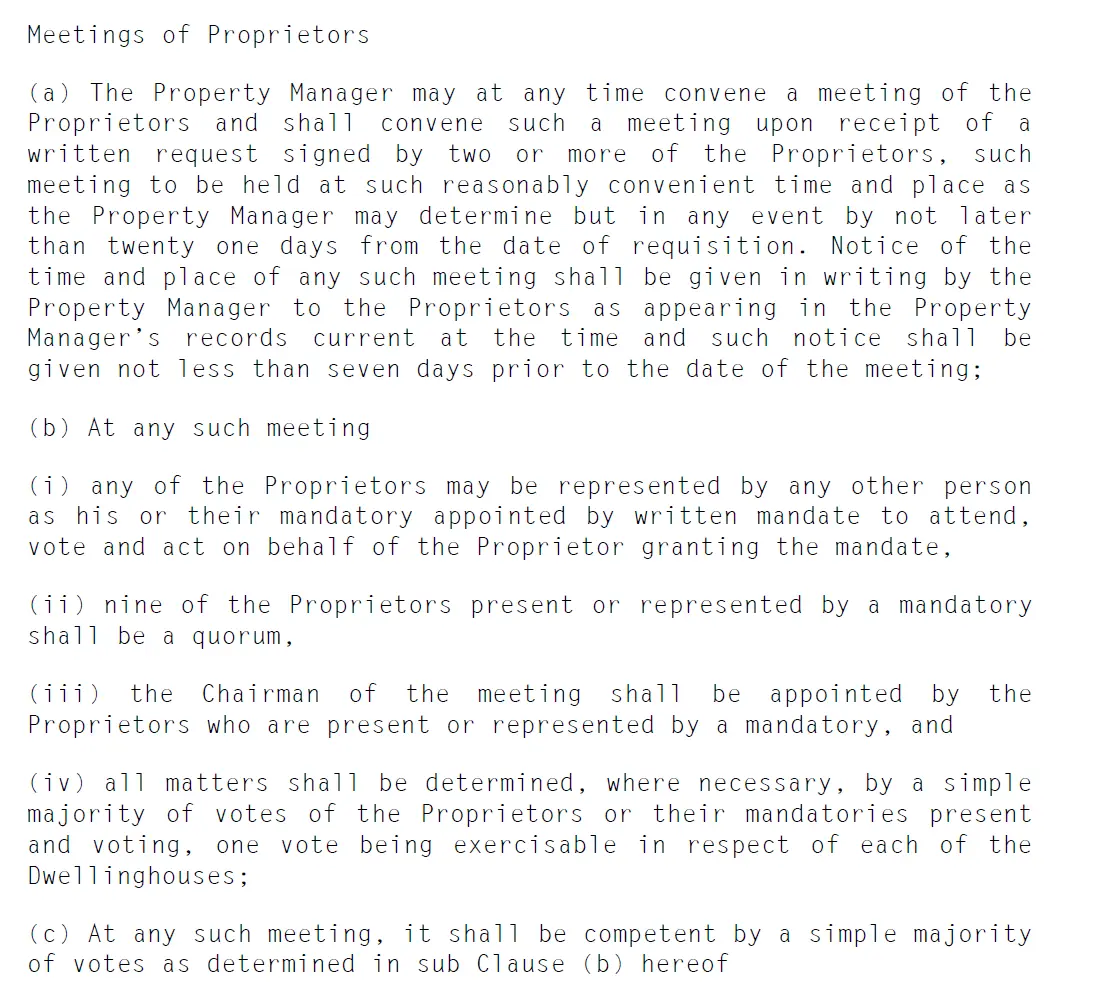
- Read your deeds first. Not every modern development has a manager burden, and some deeds contain additional procedures for calling a meeting or counting a vote. The deeds decide which route applies to you, and whether the burden has expired.
- Count flats, not people. The majority is of the units in the development. Absent owners and landlords are part of the count, so contact details matter, and a vote that is not properly notified to every owner is open to challenge.
- Documentation matters more, not less. A lower threshold means more votes will happen, and close votes attract challenge. Notify every owner, record the vote properly, and confirm the outcome to the outgoing factor in writing.
- The wider direction is owner empowerment. The same Act also strengthens the inspection powers that apply to registered property factors. More owner choice on one side, more accountability on the other. We think both are good for the sector.
Frequently asked questions
Is the Housing (Scotland) Act 2025 in force?
The provisions on dismissing and appointing a manager have been in force since 1 April 2026. Other parts of the Act commence on dates set by the Scottish Government; the current position for any section is on legislation.gov.uk.
Does it apply to our development if it is not a new build?
Yes, if your deeds entrench a factor or set a threshold above a simple majority for removing one. The change is to the Title Conditions (Scotland) Act 2003, which governs those deed provisions wherever they appear.
Can we remove the factor the developer appointed straight away?
Only once any manager burden in the deeds has expired. While it is running, the named factor generally cannot be removed. After it ends, a simple majority can dismiss them and appoint a replacement.
What vote do we need to change factor?
More than half of the flats, in almost every case now: either under your deeds as amended by the 2025 Act, or under the Tenement Management Scheme where the deeds are silent. The Scottish Government's guidance on changing or removing a property factor sets out the steps.
Thinking about a change?
Our guide to changing property factor in Scotland covers the whole journey: checking your title deeds, organising neighbours, gathering quotes, running the vote and completing the handover. If you want to see what a replacement looks like, our Edinburgh factoring page sets out what we do, what it costs and who we work with. And you do not need to have everything worked out before speaking to us.
General information only. Individual title deeds and circumstances differ.